Showing posts with label social. Show all posts

How to know it is a good area when purchasing a property in Ireland?

One of the common questions when purchasing a property is the area, which might be an important factor to make a final decision on top of the price and condition of a property. In this post, I will briefly introduce the Pobal HP Deprivation Index, which could provide a good overview of different aspects regarding an area of your interests. Although things can change and the people living in that area can change as well as time goes, this at least gives a good reference with public data collected in a certain year.

What is Pobal HP Deprivation Index?

The Pobal HP Deprivation Index is a series of maps measuring the relative affluence or disadvantage of a particular geographical area in the Republic of Ireland, using data compiled from various censuses. 


How to know whether it is a good area when purchasing a property in Ireland using the Pobal HP Deprivation Index?

The website (click the hyperlink) provides a great visualization about the index using different datasets from various years. 

You can zoom in to an area of your interests and click the button highlighted in red below on the right top area of the page, which allows you to select one of the data sources. 


For instance, the updated screenshot below shows the results when we choose the "2016-By Small Area" data source for our visualization. You can choose different data sources and have a look based on those sources.


The colors represent the degree of affluence in that small area, e.g., the orange color indicates "extremely disadvantaged" while the dark blue indicates "extremely affluent".


You could also click a specific small area to delve into details about that area. For example, the figure below shows some useful statistics about the chosen area such as:
  • Total population
  • 3rd level education percentage
  • Local authority rented/Social housing percentage 
  • Unemployment rate (%)
  • ...
  • ...


As you might expect, normally speaking, the property/housing price tends to be higher in those affluent areas when you look at prices listed on Daft.ie compared to less affluent ones.

It would be even better if there is data about recent years, but the most recent year seems to be 2016. So there might be some changes of the areas during the past years as well. Leave a comment or share the post in case it is helpful!

Hypertext2017 Travel Report


I participated the 28th ACM Conference on Hypertext and Social Media (HT), which was located at Prague, Czech Republic from 4-7th, July. HT is a top-tier ACM conference in the areas of Hypertext and Social Media. This is the first time I'm attending HT, and interesting to know that TBL was demonstrated WWW in 1991 Hypertext conference https://home.cern/images/2014/01/tim-berners-lee-demonstrates-world-wide-web. https://www.quora.com/Why-is-Sir-Tim-Berners-Lee-unnoticed-when-his-contribution-is-comparable-to-Jobs-and-Gates. This year, HT has 69 regular paper submissions with a 27% acceptance rate, and 12 short-presentations. As I was at UMAP conference twice before, and HT has been held in close proximity with UMAP with similar program committees, I was wondering what's the difference between the two conferences. After attending the conference, I guess the key difference is while UMAP is more focused on the context of e-learning, such as user modeling, RecSys in educational systems, HT is more focused on linking data & resources and Social Media. Although HT has wide range of acceptance rate, overall, it has good average citation according to ACM DL.


Day-1:

Keynote: Peter Mika SCHIBSTED (Yahoo before)

It is interesting to see the keynote on Semantic Web in HT. In this talk, we look back at the history of the Semantic Web. The speaker discussed what the original aspirations of its creators were, and what has been achieved in practice in these two decades including some achievements especially in terms of search engines. In addition, also some failures which have not been achieved based on original visions.


What happened to the Semantic Web? from Peter Mika

Most of the presentations today related to studying problems on Social Media, such as hate speech:

  • Mainack Mondal, Leandro Augusto de Araújo Silva and Fabrício Benevenuto: A Measurement Study of Hate Speech in Social Media
  • Stringhini and Athena Vakali: Hate is not binary: Studying abusive behavior of #GamerGate on Twitter
These talks were interesting as I was interested in computational social science when I first started my PhD. For example, the first one above discussed about "how to measure hate speech?", "does the anonymity plays a role in it?", and how these phenomena differ across countries. The results, based on Twitter dataset were interesting. The authors found that there are more anonymous account of hate speech compared to baseline (random), i.e, users post more hate speech.

Day-2:

Keynote: "A MEME IS NOT A VIRUS: THE ROLE OF COGNITIVE HEURISTICS IN INFORMATION DIFFUSION" by Kristina Lerman

Kristina Lerman is Research Team Lead at the University of Southern California Information Sciences Institute and holds a joint appointment as a Research Associate Professor in the USC Computer Science Department. She talked about position bias in Social Mdedia, e.g., posts will be less likely to be seen with lower position, with more newer tweets coming, former tweets then become less likely to be seen with their positions moving down… and the phenomenon is more serious for well-connected users. Also, it is interesting that well-connected hubs are less likely to retweet older posts, retweet probability decreases with connectivity - highly connected people are less susceptible to infection, due to their increased cognitive load.

The presentations on day-2 were diverse, consists of linking content, crowd sourcing, story telling... And the following paper which tackles the problem of understanding task clarity in crowdsourcing platforms, especially CrowedFlow…, and how to measure it, won the best paper award in HT2017.

  • Ujwal Gadiraju, Jie Yang and Alessandro Bozzon: Clarity is a Worthwhile Quality - On the Role of Task Clarity in Microtask Crowdsourcing


Day-3:

The presentations on day-3 were about location-based social networks, user modeling, ratings/reviews and visualizations. One of the interesting papers was the following one which I had read about the previous work about happy map done by Daniele QUercia (Bell Labs Cambridge). This paper talked about various elements which might affect perceptions (such as safety etc.) of people about places.

  • David Candeia, Flávio Figueiredo, Nazareno Andrade and Daniele Quercia: Multiple Images of the City: Unveiling Group-Specific Urban Perceptions through a Crowdsourcing Game

My presentation was about "Leveraging Followee List Memberships for Inferring User Interests for Passive Users on Twitter", which is an extended work upon previous work in ECIR2017.


Leveraging Followee List Memberships for Inferring User Interests for Passive Users on Twitter from GUANGYUAN PIAO


Overall, the conference has around 70+ participants. However, what's impressive is the audiences were actively asking questions, and participated in discussions. In addition, the organizers made the proceedings available before the conference along with conference navigator developed by Uni. Pittsburgh: http://halley.exp.sis.pitt.edu/cn3/portalindex.php

Proceedings: http://dl.acm.org/citation.cfm?id=3078714&picked=prox&cfid=782021270&cftoken=32813465

Next year, HT2018 will be in Baltimore, USA. It is a good conference and hope I will have chances to attend the conference in the future as well.

W3C F2F meeting experience

It was a great experience to attend a F2F meeting of the W3C working group for the first time. Occasionally attend the meeting in INRIA Paris instead of my supervisor and had a good chance to learn how the standardization organization like the W3C working group is making progress. 

The two days meeting focused on resolving open issues of the Social Web Working Group and had several demonstrations on three different API candidates from different communities namely Micropub from IndieWebCamp, ActivityPump and SoLiD.

It is impressive to implement and test based on real world applications like the guy using the SIOC ontology in a Web chat application - http://webid.im/.

Summary: A working group consists of a diversity of people from multiple communities, industries and academies with the same goal:) which can contribute different perspectives.

Working on the condition of online bases normally, the issues open by members should be actionable which is important for making progress and get things done by a deadline.

Didn't actively involved in the conversation since the focus is on APIs, should have done more studies before attending the meeting.

Have a chance to see Tim Berners-Lee in person:). 


Google Social Graph API & OpenSocial

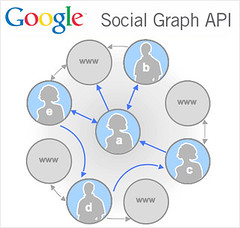
Figure 1
Launched by Google in 2008 and was fully retired in April 20, 2012. The API lets developers locate links that make use of the XFN and FOAF labeling systems. For XFN as an example, if I add the personal or external URL (http://about.me/parklize) in my Twitter profile page (http://twitter.com/parklize) then you will find the rel="me" indication of the link as Fig.2. 
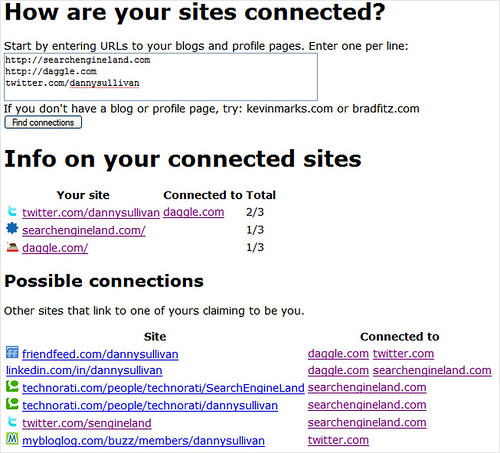
Figure 2
Even though the API is deprecated, the following figure shows how it was working. It can get possible connections based on the URLs added based on the index of XFN and FOAF as mentioned above.


Besides, the OpenSocial, which has an ambiguous name with the Social Graph API led by Google as well is totally different and unrelated to each other. The difference is described in [2] as below:

Though the names are similar, Social Graph API is unrelated to OpenSocial.
  • The Social Graph API was a means to access a crawl we did of XFN and other public graph data.
  • OpenSocial is a standard set of APIs for embedding social gadgets in websites.

They’re both APIs, but APIs to different data, satisfying different use cases.

And recently W3C and the OpenSocial Foundation announced that as of 1 January 2015, OpenSocial standards work and specifications beyond OpenSocial 2.5.1 will take place in the W3C Social Web Working Group, of which the OpenSocial Foundation is a founding member. The W3C Social Web Working Group extends the reach of OpenSocial into the enterprise, HTML5 and Indie Web communities.


Social Network API Test


  • What can obtain from Graph API in Facebook? (Assume user is not using my app)
    1. Search by name: https://graph.facebook.com/v2.2/search?q=Guangyuan+Piao&type=user&access_token="your access token"
    2. Get name, id
    3. Search user information by id: https://graph.facebook.com/v2.2/id
    4. Get id, first_name, last_name, link, name, updated_time

  • Limit on Google Plus API?
    1. per day (10,000) and per second (5)

  • Limit on Twitter API?
    1. user look up 180/time_window (15min in v.1.1)
    2. get user timeline 180/time_window (15min in v.1.1)
    3. How to get user timeline with paging?
- The example below get 100 statuses / page for 10 times (for loop) to get maximum 1000 tweets from user timeline.
- However, because every call for getUserTimeline() will use one rate, it is better to check the status list and break the look if there's no more status in the current page....

1:  for (int j=1; j<11; j++) {  
2:        Paging page = new Paging (j, 100); // page number, number per page  
3:        List<Status> statuses = twitter.getUserTimeline(user.getId(), page); // rate will for -1 each call  
4:       if (statuses.size() < 1) {  
5:              break;  
6:       }   
7:  }  


  • Twitter Helper 


1:    TwitterFactory factory;  
2:    Twitter twitter;  
3:       public TwitterHelper() {  
4:            // Configuration of Twitter API  
5:            ConfigurationBuilder cb = new ConfigurationBuilder();  
6:       cb.setDebugEnabled(false)  
7:        .setOAuthConsumerKey(consumerKey)  
8:        .setOAuthConsumerSecret(consumerSecret)  
9:        .setOAuthAccessToken(accessToken)  
10:        .setOAuthAccessTokenSecret(accessSecret);  
11:      // Initialize Twitter Instance  
12:      factory = new TwitterFactory(cb.build());  
13:      twitter = factory.getInstance();  
14:       }  
15:       public int getStatusesRemainingRate() {  // check /statuses/user_timeline endpoint remaining rate

16:            int i = 0;  
17:            RateLimitStatus status;  
18:            try {  
19:                 status = twitter.getRateLimitStatus().get("/statuses/user_timeline");  
20:                 i = status.getRemaining();  
21:            } catch (TwitterException e) {  
22:                 System.out.println(e.getMessage());  
23:            }  
24:            return i;  
25:       }